
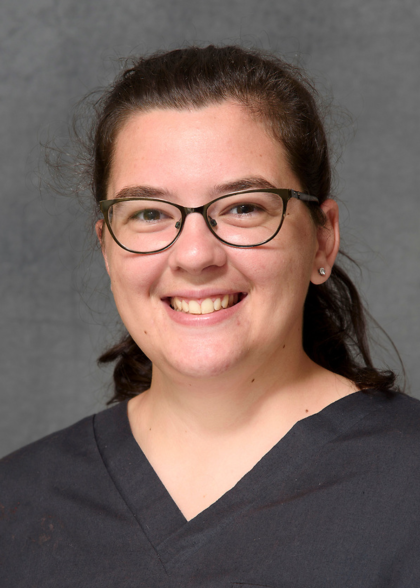
Jill Hudnall
College of Veterinary Medicine
Years in Position: 3
Years of Service to MSU: 5
Jill Hudnall did not set out to build a career studying marine mammals and sea turtles. What began as a student job in the College of Veterinary Medicine’s diagnostic laboratory at Mississippi State University laid the foundation for a career focused on aquatic animal health, parasitology and conservation.
“I tell people I stumbled into this field. What started as a student worker opportunity quickly turned into a passion and career path that I truly enjoy,” Hudnall said.
After graduating with a degree in animal and dairy sciences with a pre-veterinary concentration and a minor in international studies in agriculture, Hudnall was hired as a full-time diagnostic laboratory technician. Two years later, she transitioned into her current role as a research associate with the Global Center for Aquatic Health and Food Security.
“I like to tell people what I don’t do instead of trying to explain all the details of my work,” Hudnall said.
In short, Hudnall supports funded research projects focused on the health of marine mammals and sea turtles in the Mississippi Sound, though what that looks like day to day depends heavily on the time of year.
From February through June or July, the Mississippi Sound enters stranding season — a stretch of months when elevated numbers of sick or deceased marine mammals and sea turtles are reported along the coast. The season also coincides with dolphin calving season, making it one of the most demanding periods of the year.
During that time, Hudnall is immersed in the lab, entering necropsy data, performing necropsies, archiving tissue samples and preparing histology materials for pathologists.
A central focus of her work — and the subject of her master’s thesis at the MSU College of Veterinary Medicine — is marine mammal and sea turtle parasitology. Hudnall is pursuing a master’s degree in veterinary medical science with a concentration in infectious disease and an emphasis in parasitology and expects to graduate in December 2026.
After a necropsy is complete, remnant tissues from organs such as the lungs and gastrointestinal tract can still yield important data. Hudnall screens and collects parasite specimens, preserves them and conducts morphological and molecular identification for diagnostic and publication purposes. She also performs data mining, contributes to literature reviews and assists in writing scientific publications.
“The information we collect can help identify disease trends, environmental concerns and conservation needs that affect not only marine wildlife, but also the broader concept of One Health and its impact on humans,” she said.
Hudnall brings that research to schools, community events and veterinary professionals year-round, educating audiences on marine mammals, sea turtles, parasitology and conservation.
“Many people are unable to travel or experience marine wildlife firsthand, so being able to share what we do through outreach events, school programs and public education is incredibly rewarding,” she said.
One of her proudest moments came when she was selected to present marine mammal parasite collection techniques to an audience of international scientists and leaders in the field.
“It was daunting because I am still early in my research career, but I was able to share valuable information on marine parasitology, which is a small but rewarding aspect of conservation,” Hudnall said.
When she is not working or studying, Hudnall tends to what friends affectionately call her personal zoo: a Dalmatian named Ivy, an Australian shepherd named Delilah, a cockatiel, a green-cheek conure, lizards and spiders.
She and Ivy frequently compete on the dog sports circuit, traveling across the Southeast for events. In her remaining downtime, she enjoys pony driving, reading and gaming.
Date