
Vision 2030: Identifying Mississippi's value-added leakage
What if we could add billions to Mississippi's economy, revitalize our rural communities, and build a stronger future for the next generation? That's the question behind Vision 2030, a strategic plan to strengthen agriculture and forestry—the backbone of the state’s economy.
Agriculture and forestry generate nearly $46.2 billion annually and account for one in every nine jobs in Mississippi. Despite this success, 75% of what the state produces leaves Mississippi, and more than half is processed elsewhere into higher-value products. This value-added leakage costs Mississippi over $10 billion each year in lost jobs and opportunities.
"We are not capturing our full economic potential," said Keith Coble, vice president of the Mississippi State University Division of Agriculture, Forestry and Veterinary Medicine. "This isn't just about growing more crops or harvesting more timber—it's about keeping the value of what we already produce right here in Mississippi, creating better-paying jobs and revitalizing rural communities.”
Plugging the Leaks
To better understand where Mississippi is losing ground, MSU economists James Barnes and James Henderson are leading a Value-Added Leakage Study, analyzing more than 100 agricultural and forestry commodities.
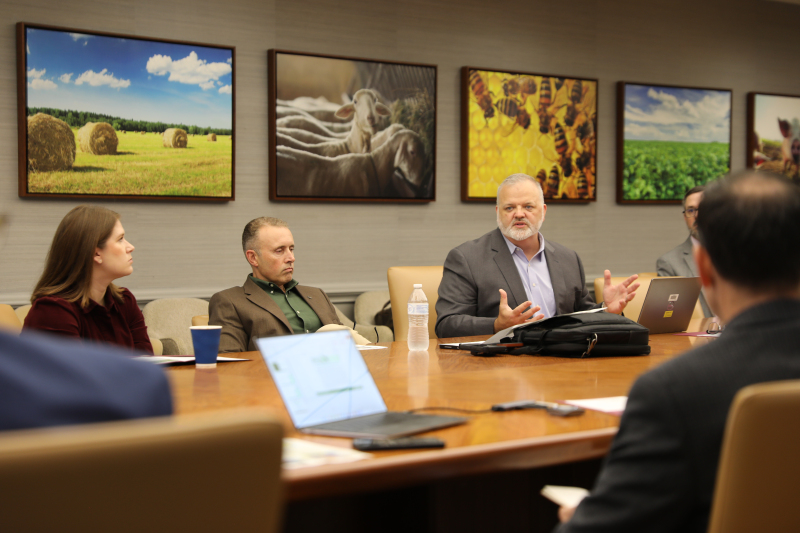
“Our preliminary results indicate substantial opportunities for our state,” said Henderson. “We don’t expect to be able to keep everything we grow in-state, but even closing part of the gap could transform our economy.”
Consider dimension lumber. Each year, Mississippi sells $1.5 billion in Southern Yellow Pine lumber to companies outside the state, much of which is turned into engineered wood products, such as cross-laminated timber, or CLT.
Poultry, the state’s number one commodity, tells a similar story. Mississippi sells $1.6 billion in processed poultry products to out-of-state businesses, many of which are further processed before reaching the consumer.
“Retaining even a portion of these commodities for processing would lead to increased economic activity and job creation,” said Barnes. “The longer a product can stay within Mississippi for all stages of processing before selling to the end consumer, the better.”
Task Forces and Priorities
Vision 2030 focuses on six critical areas where the state has both need and potential: artificial intelligence, specialty crops, agronomic crops, animal systems, conservation and resiliency, and population change and community vitality. These priorities emerged directly from conversations with stakeholders.
The specialty crops task force proposes investing in processing facilities and cold storage infrastructure to support these niche markets.
The artificial intelligence task force is developing strategies to equip farmers, educators, and communities with cutting-edge tools, building on the foundation of MSU's Agricultural Autonomy Institute. The long-term goals are ambitious: creating a statewide data infrastructure, developing virtual modeling tools for livestock and forest management, and launching certification programs to prepare a tech-savvy, AI-ready workforce.
The animal systems and agronomic crops task forces are similarly focused on modernization. The plan is to boost the animal systems industry through advanced monitoring technologies and stronger collaboration between producers and veterinarians. At the same time, the agronomic crops strategy aims to modernize the agricultural workforce and prepare for generational turnover on family farms.
Vision 2030 isn’t just about agriculture and forestry—it’s about supporting the people who make these industries thrive. Between 2020 and 2024, 52 counties experienced net out-migration, resulting in workforce shortages and putting rural economies under pressure. By expanding value-added processing and advancing the key priorities, Vision 2030 aims to reverse that trend, creating opportunities that encourage young people to build their futures in Mississippi.
“The value of Mississippi's agriculture isn't only in what we grow, but also in what we do with it,” said Mike McCormick, president of Mississippi Farm Bureau Federation. “By identifying value-added processing opportunities and investing in technology, innovation and our communities, we're not just creating jobs for today; we're securing a future for the next generation of Mississippians to thrive right here at home.”